
EDRA GREAT PLACES AWARDS
WINNERS
EDRA's Great Places Awards seek to recognize work that combines expertise in design, research, and practice, and contributes to the creation of dynamic, humane places that engage our attention and imagination.
Our winners and honorable mention GPA recipients have been announced at the EDRA57 Annual Conference.
2026 EDRA GPA AWARDS RECIPIENTS
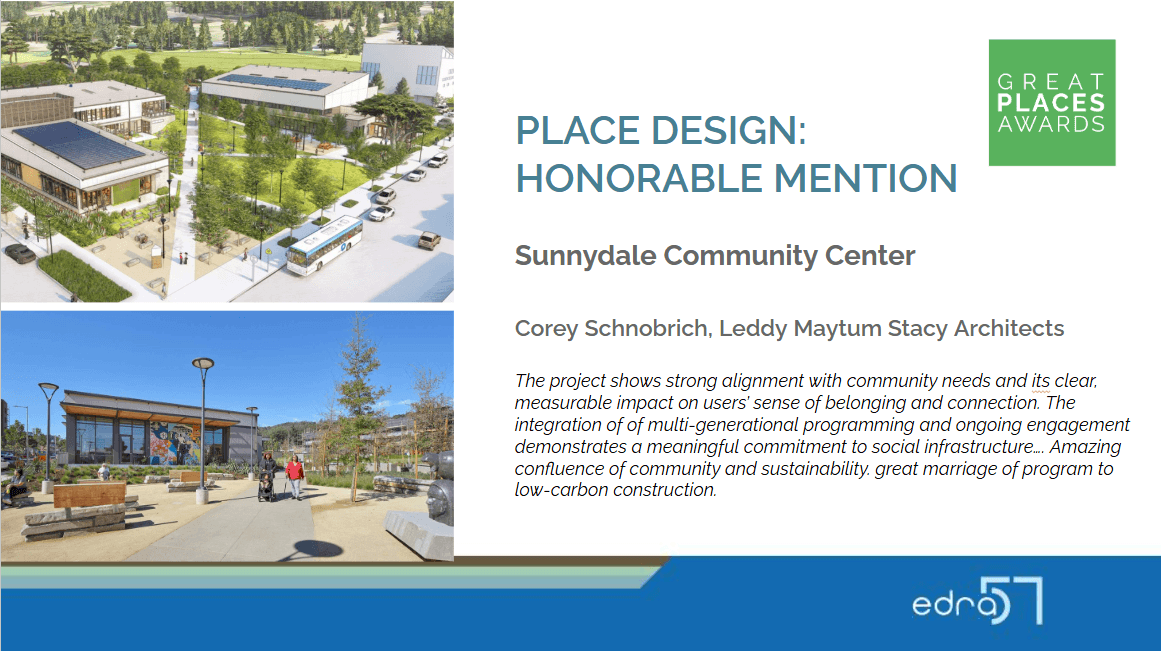
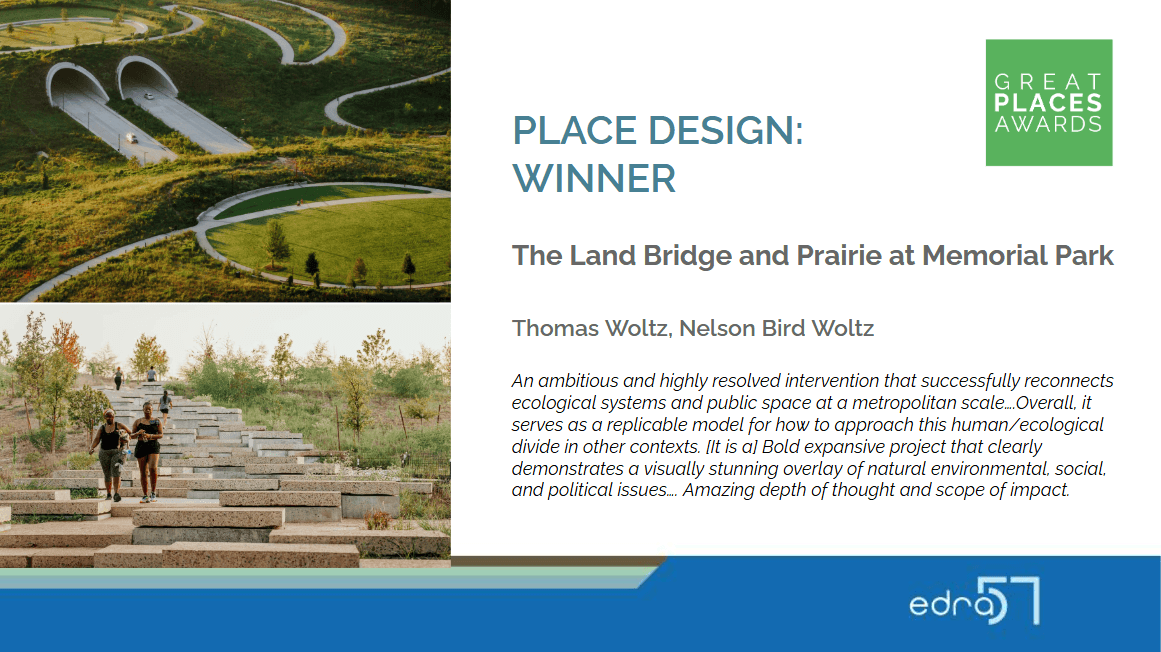
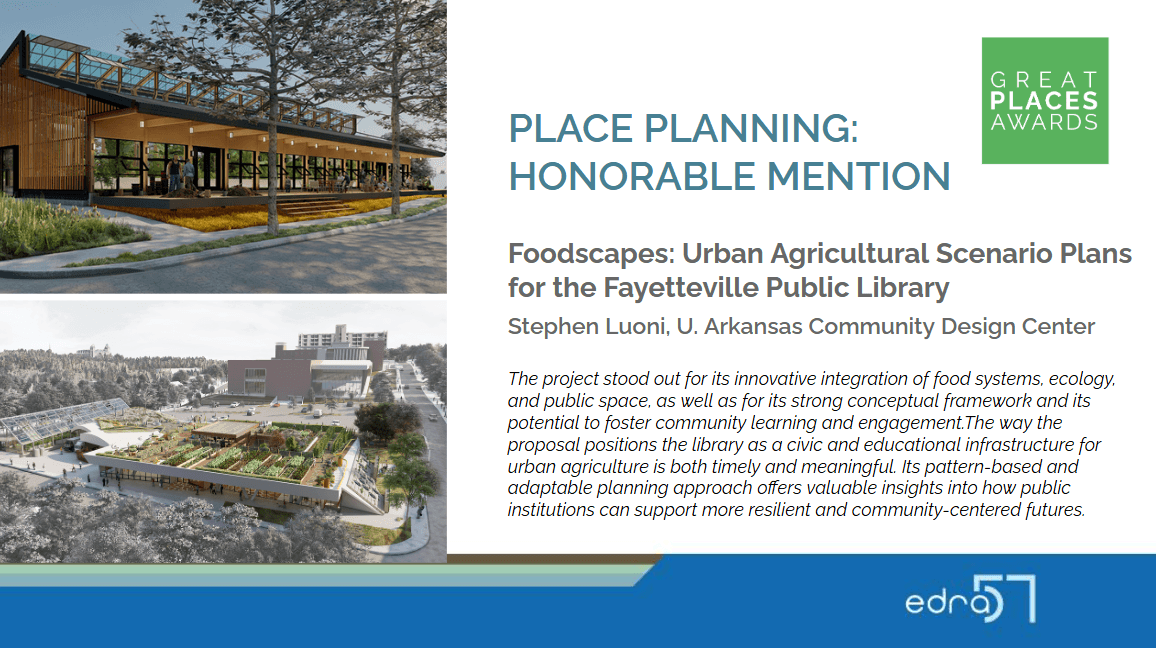
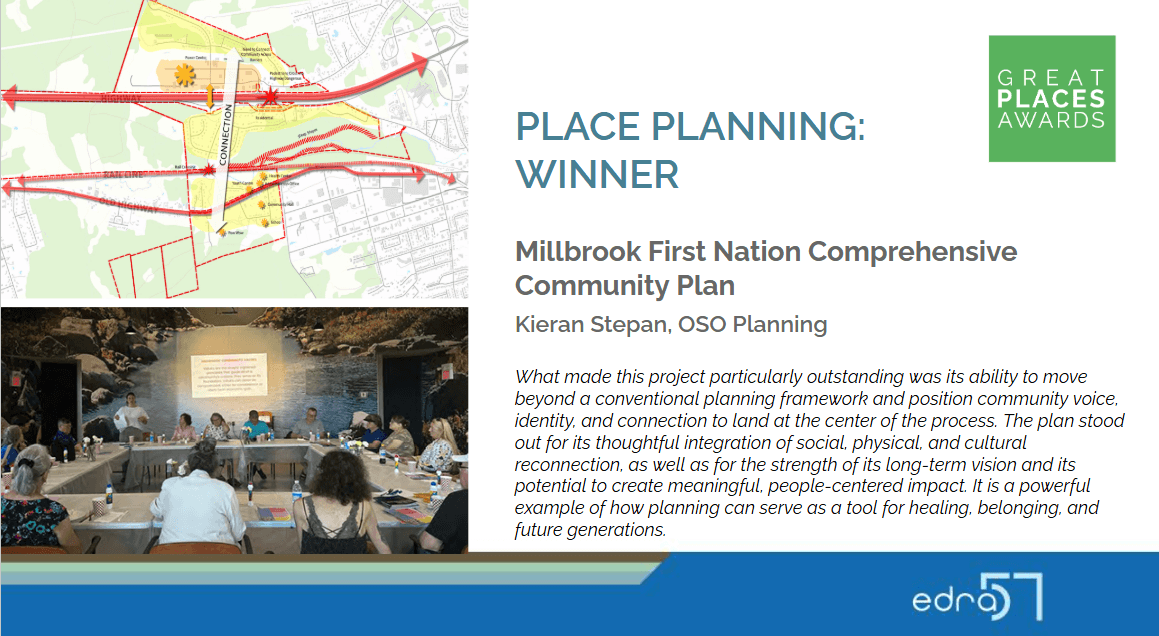
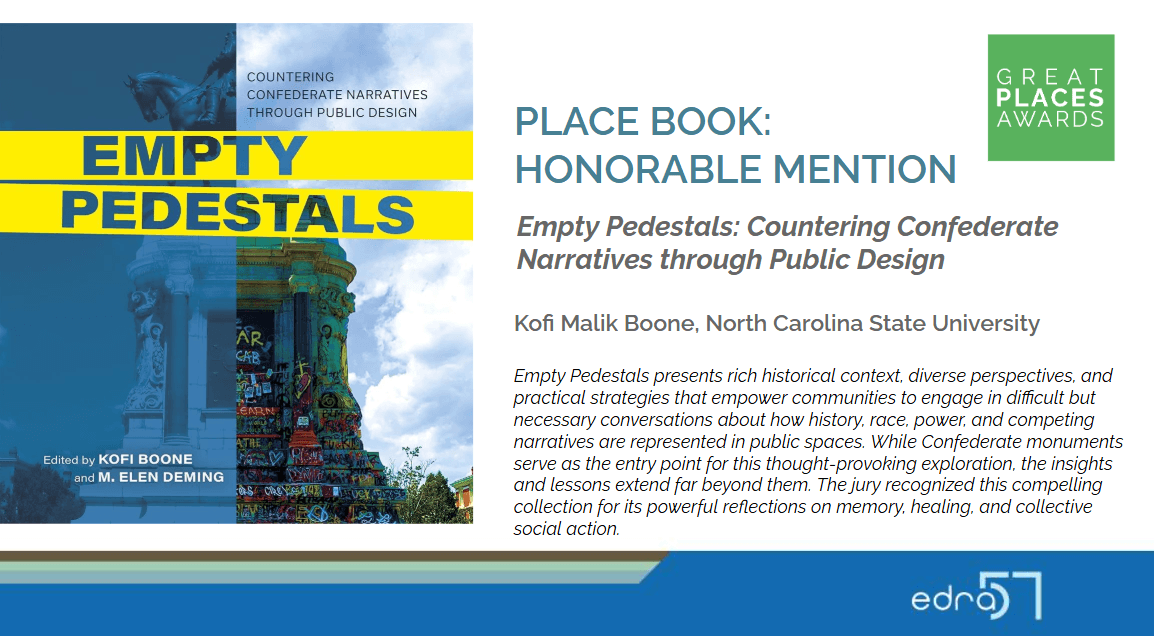
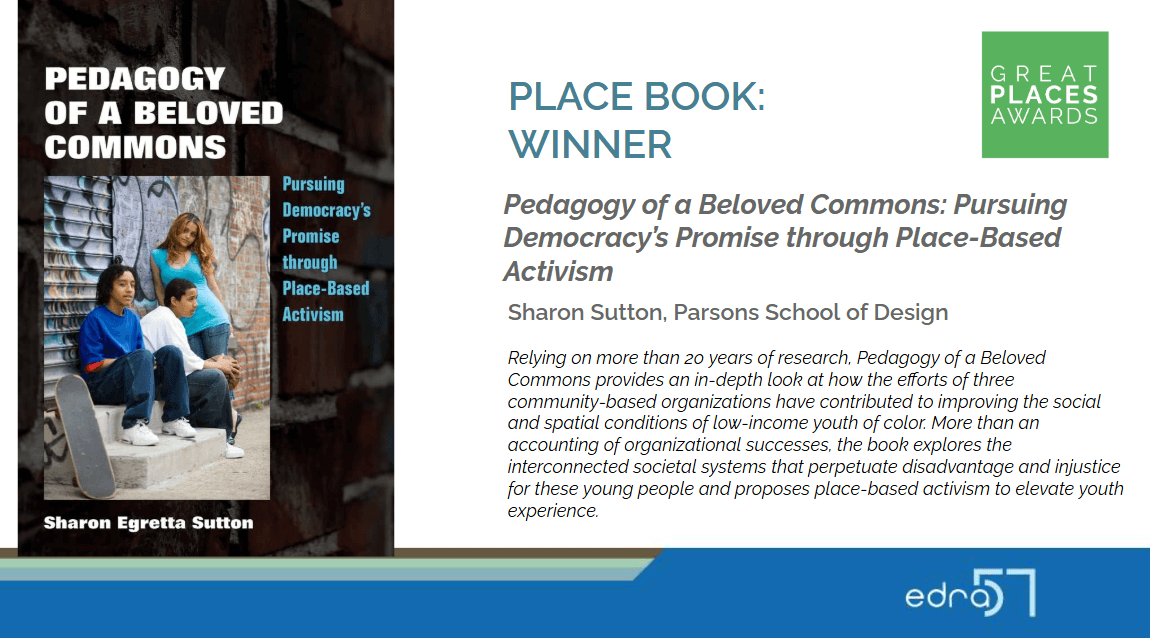
2025 EDRA GPA AWARD RECIPIENTS
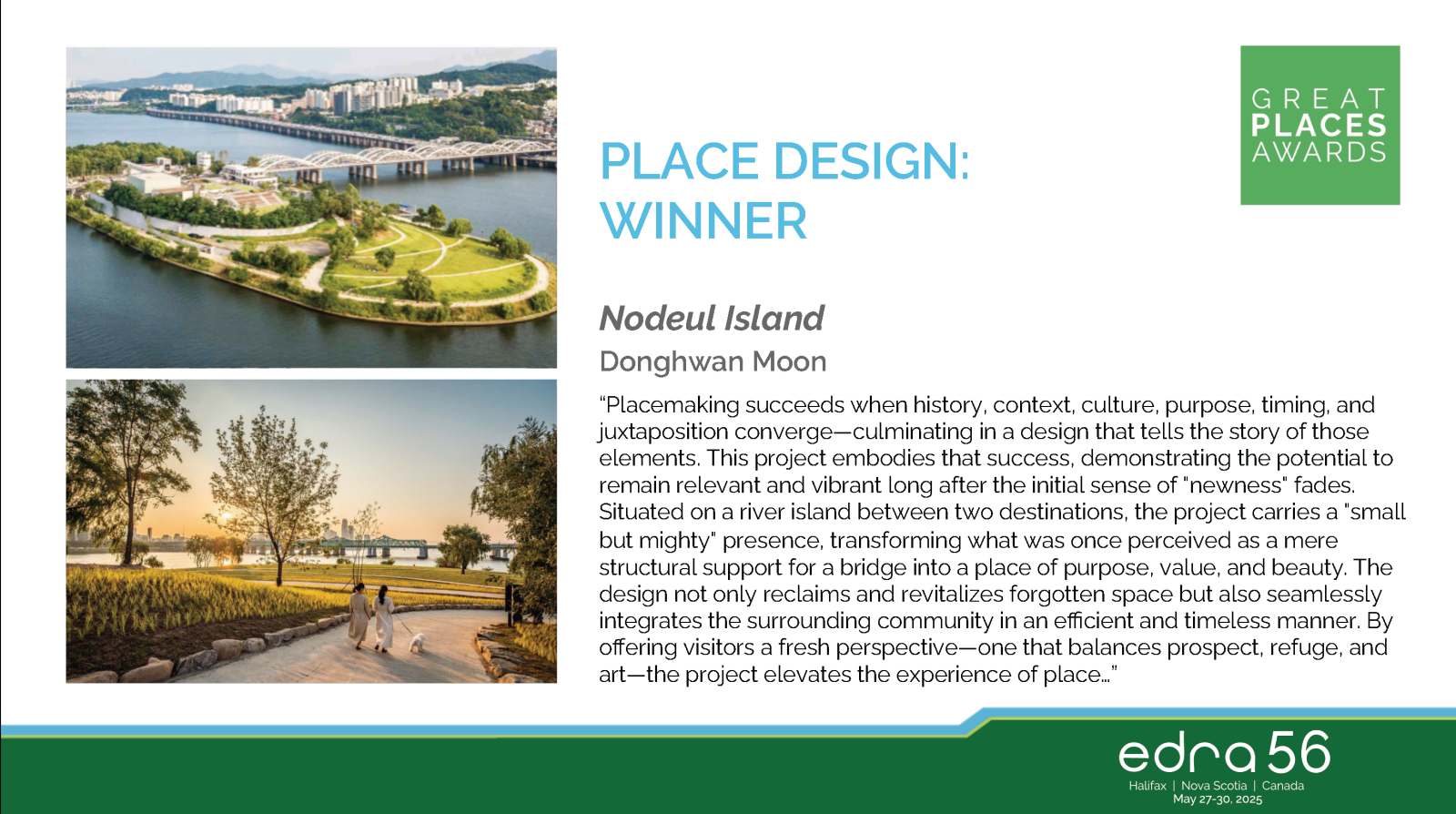
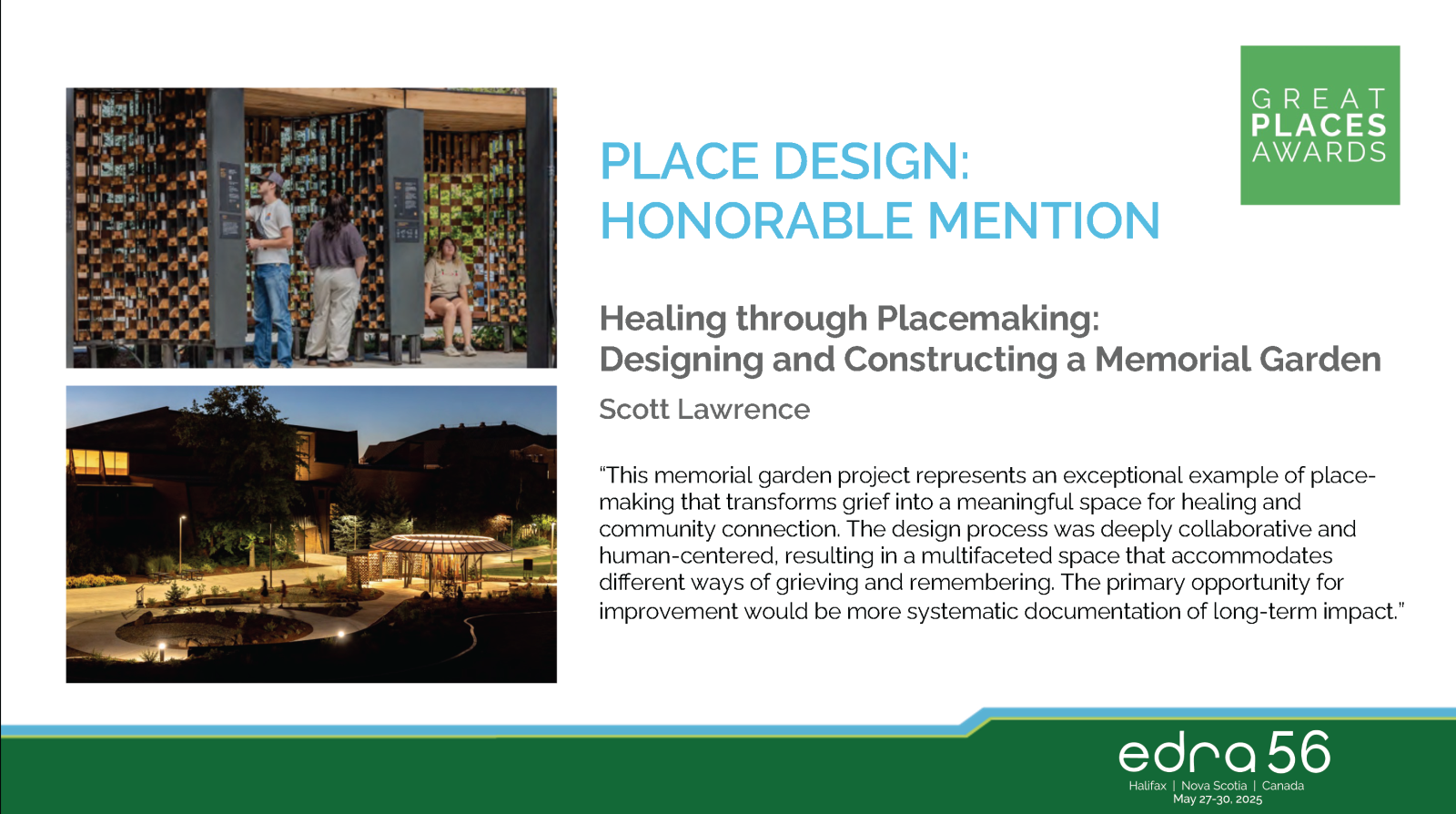
2024 EDRA GPA AWARD RECIPIENTS
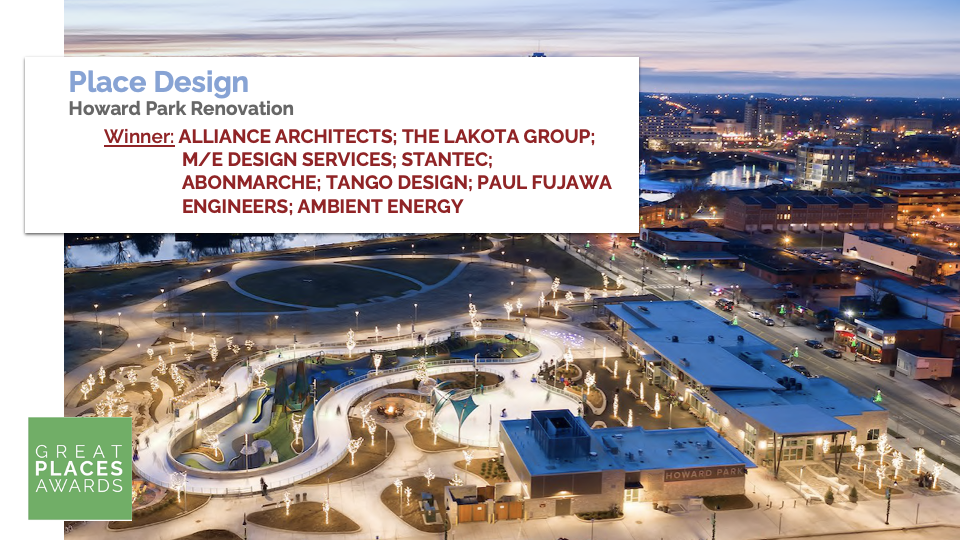
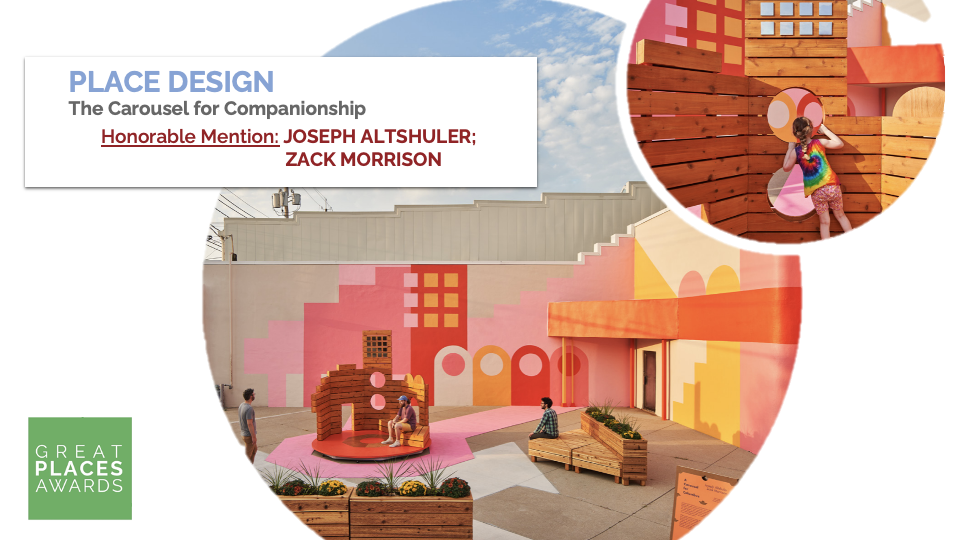
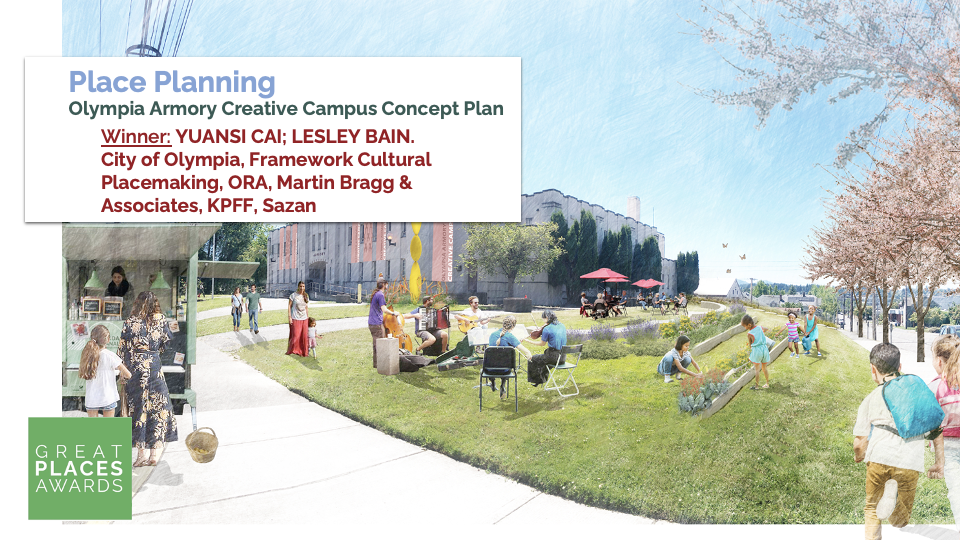
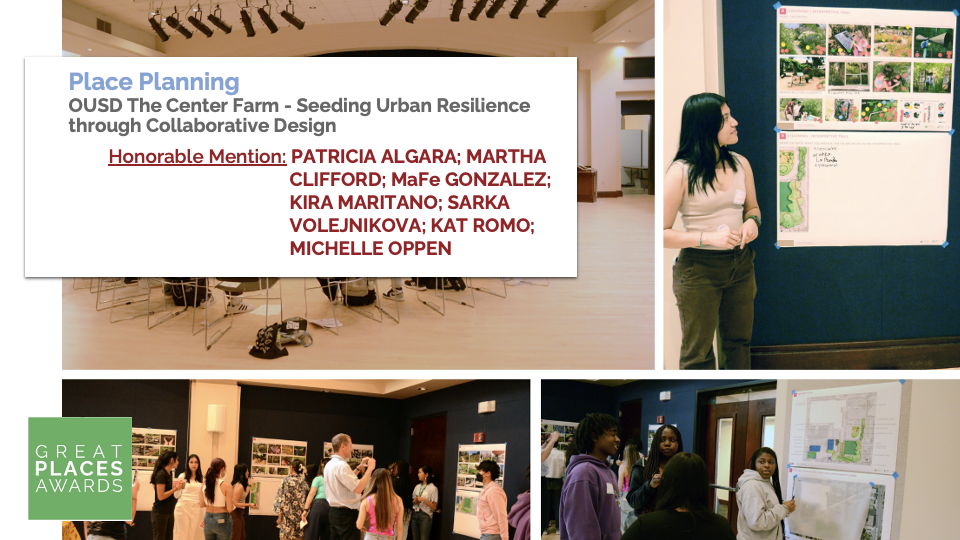
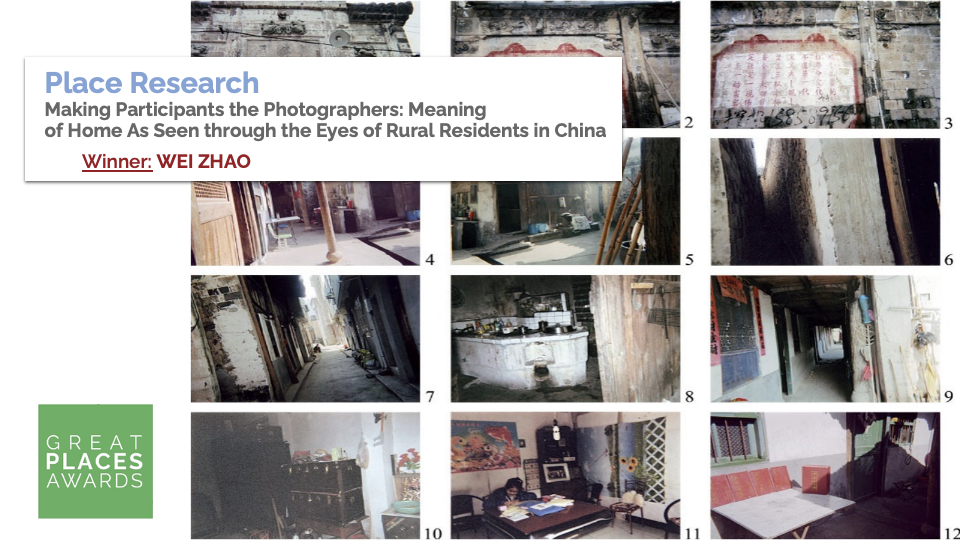
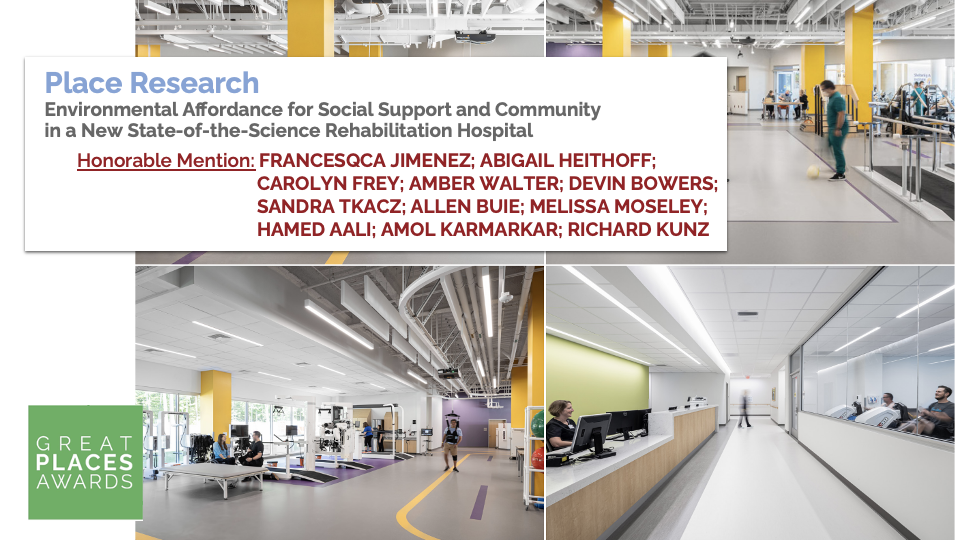
2023 EDRA GPA AWARD RECIPIENTS
PLACE DESIGN
Winner
Maritza Hernández Solis
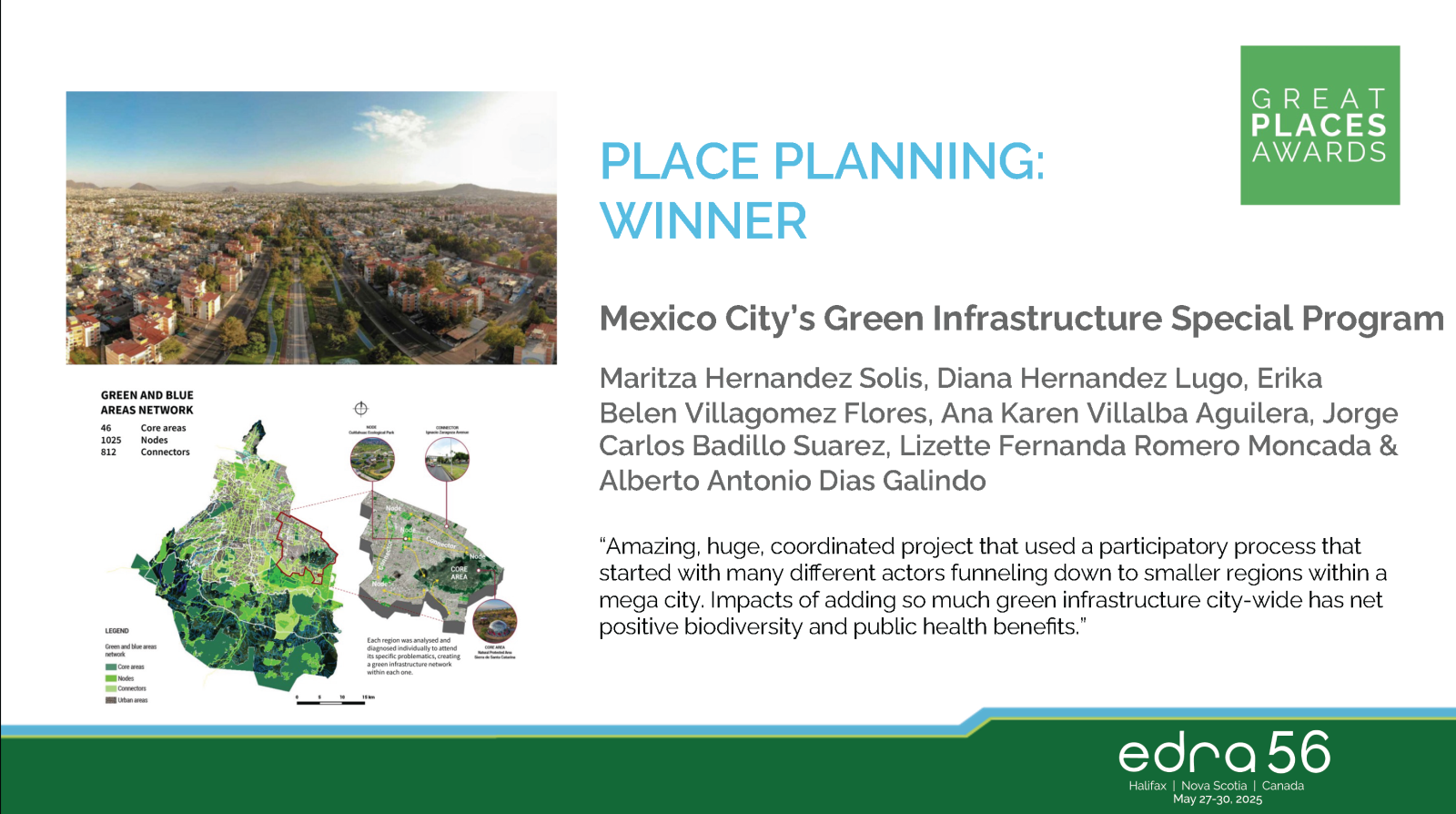
The Canal Nacional, themed around the Revival of the Lacustrine, Cultural and Environmental History of Mexico City, activates programs through detailed analysis and rich, subtle design decisions that offer results. The ambition towards a large scale green infrastructure project in Mexico City is achieved through multiple small scale solutions across the breadth of the project. Through these small scale solutions, that rethink and transform an existing canal into a community asset, the project reciprocally offers a large environmental and social impact through ecological thinking, community infrastructure and vegetation.
Honorable Mention
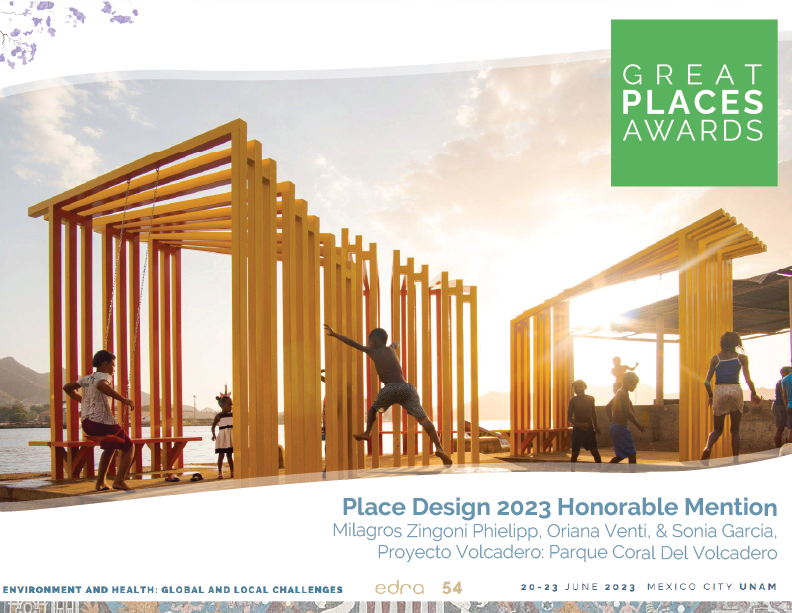
Proyecto Volcadero: Parque Coral Del Volcadero
Milagros Zingoni Phielipp, Oriana Venti, Sonia Garcia
The Proyecto Volcadero offers programming through a very engaging community process. While the project offers a small scale intervention, the design outcome offers strong contextual and formal links through social engagement.
Place Planning
Winner
Buena Vista Horace Mann K-8: Creating Space for Equitable Design
This year’s winner of the EDRA Place Planning Award is the team at Base Landscape with their Buena Vista Horace Mann School: Creating Space for Equitable Design plan. The plan centers local and traditionally marginalized voices of the working-class, Spanish-speaking Latinx school community in San Francisco’s Mission District, an area and a school both known for opening their doors to the needs of the community while suffering years of deferred maintenance and neglect. This equitable design plan showcases a thoughtful, culturally appropriate, extensive engagement process focused on rebuilding trust and removing barriers for participation in a community that has suffered years of disinvestment. The resulting design features multi-use areas with a variety of activities, places to be used by parents and family, as well as the broader community, including neighbors who don't have children attending the school. It incorporates bioswales, food-growing gardens, a new track and soccer field, outdoor classrooms with nature play, a dining area, and an amphitheater performance space for community cultural dances and events.
Honorable Mention
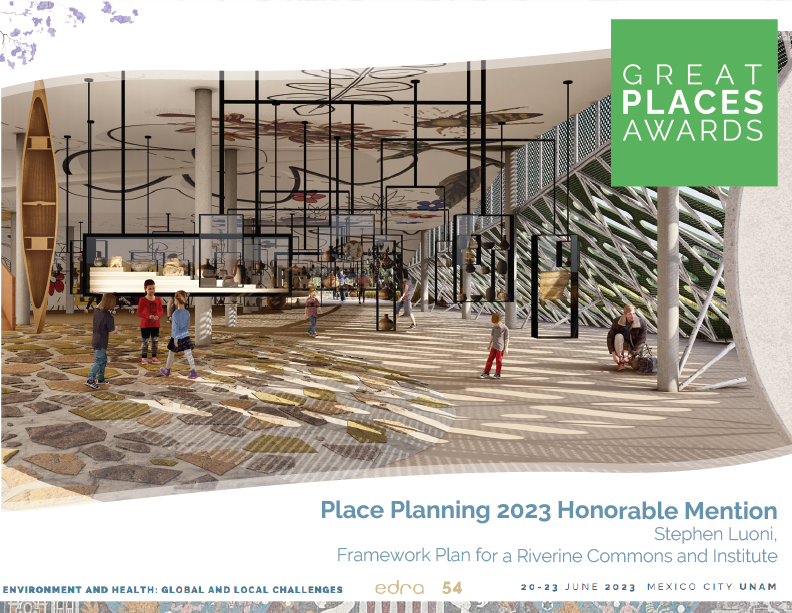
Framework Plan for a Riverine Commons and Institute
Stephen Luoni
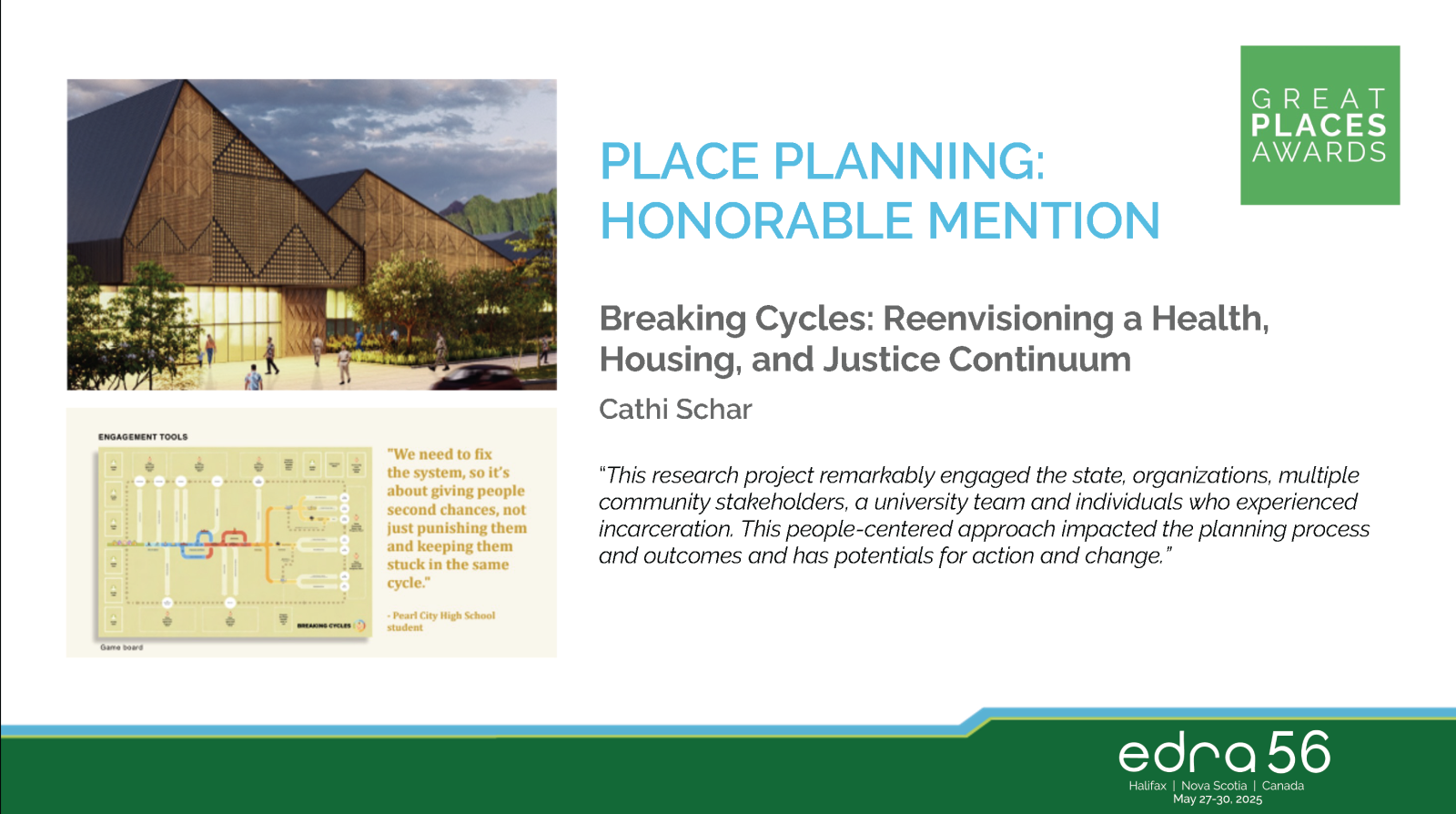
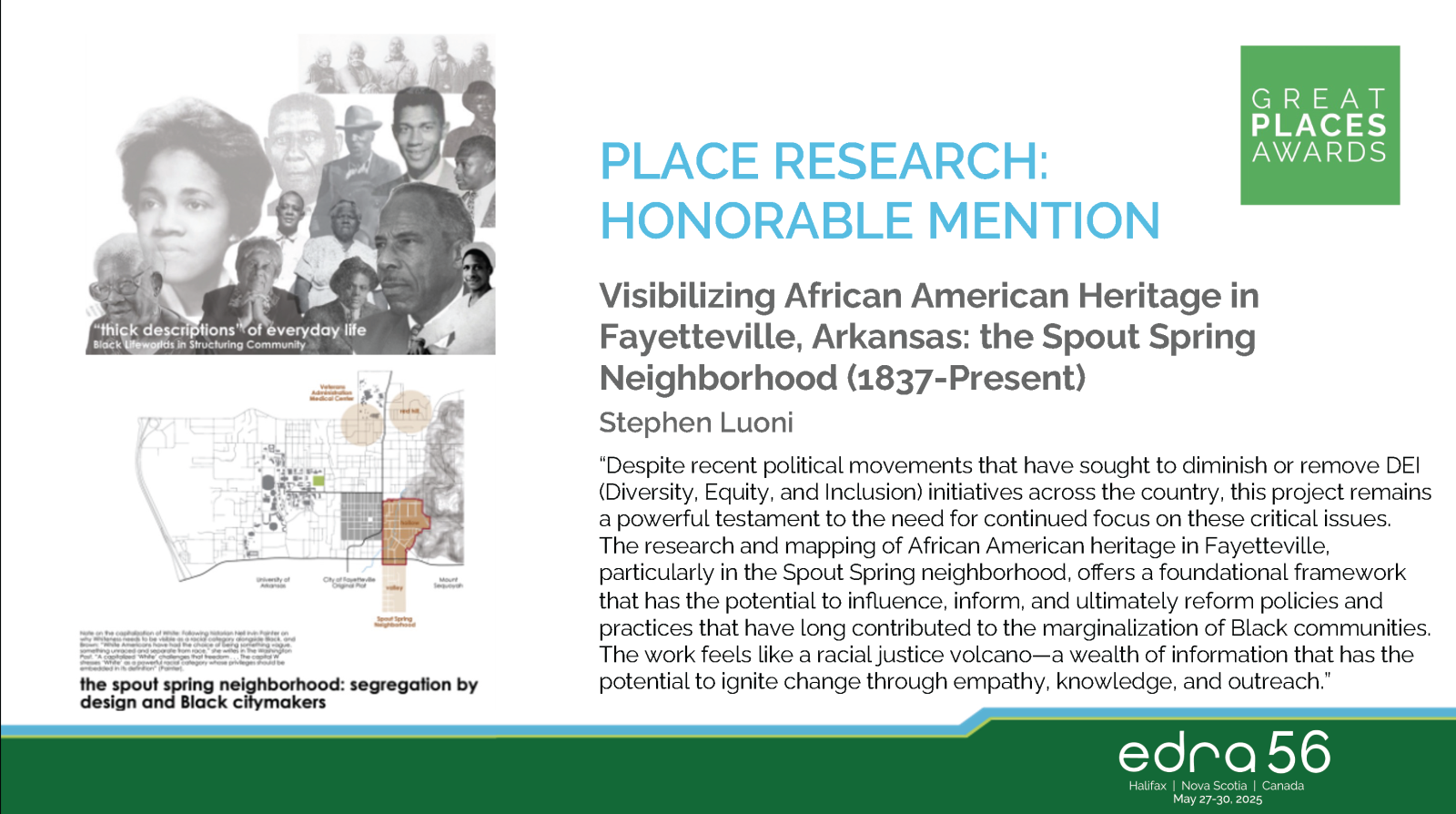
This elegant transdisciplinary project features Native American, African-American, and Euro-American settlers in the riverine context of Northwest Arkansas. The plan received support from the National Endowment for the Arts and aims to restore a healthy ecosystem while raising awareness of indigenous knowledge systems in civilizing riparian landscapes symbiotic with nature. The project expands the city of Fayetteville’s green infrastructure and riparian corridor improvements, and ties into the region’s new open space conservation plan for ecosystem preservation.
Place Research
Winner
Evaluating Human-Plant Interaction in a Public Place: A Social Media Data-Informed Evaluation Method and Application in Chicago’s Lurie Garden
Bo Zhang, Ph.D., Cheryl Mihalko, Yang Song
This study makes an important contribution to place research by using technology and social media to gather high-volume data and highlight the restorative value of public gardens. The study investigates the interaction of public space, human agency, and transaction, and considers the form of individual plants and mass with hashtag affective responses. The methods are extremely detailed and contextual, with 6700 images gathered over a 60-month period. The study contributes to our understanding of how humans specifically interact with the landscape and provides a transferable approach to how gardens are both designed and assessed for success. The documentation is clear and accessible to designers involved in developing green space, and the data is persuasively visualized. Overall, this innovative and needed study demystifies plant design through the study of human-plant interaction in a place-based context.
Honorable Mention
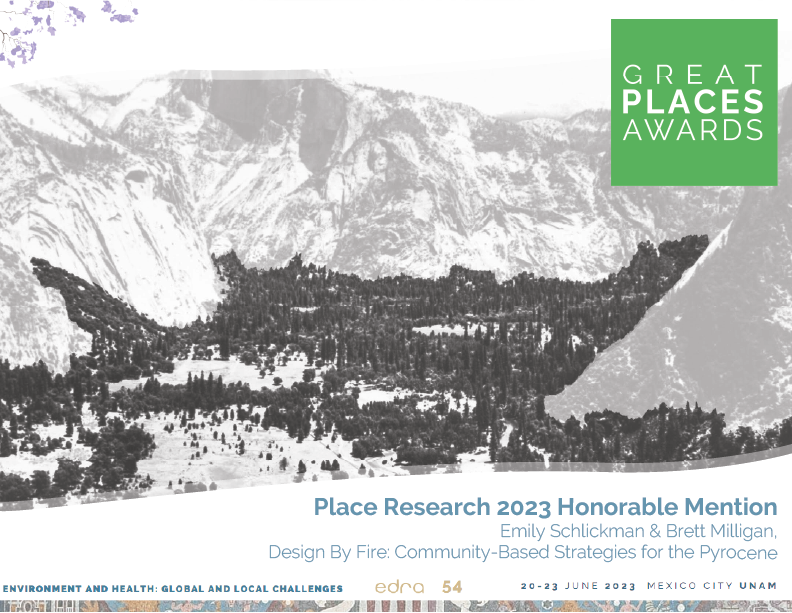
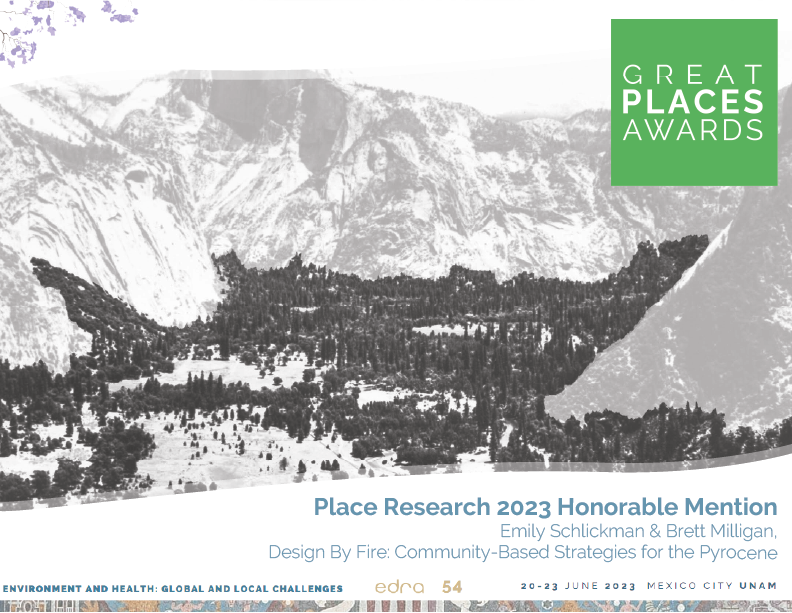
Design By Fire: Community-Based Strategies for the Pyrocene
This innovative study, directed as a book project, focuses on community-based strategies for addressing wildfires and their impact on wilderness urban interfaces. The topic area is timely given the recent devastation of fires, and the study presents well-crafted graphical illustrations that describe fire mitigation strategies. The study includes fieldwork, mapping, drone imaging, and interviews, providing a useful guide on twenty-seven community-based techniques. However, the submission lacks a summary of the associated literature, and the methods are not explicitly described. Overall, this study has the potential for broader impacts both nationally and internationally in terms of life safety, and it contextualizes spatial techniques in terms of human action.
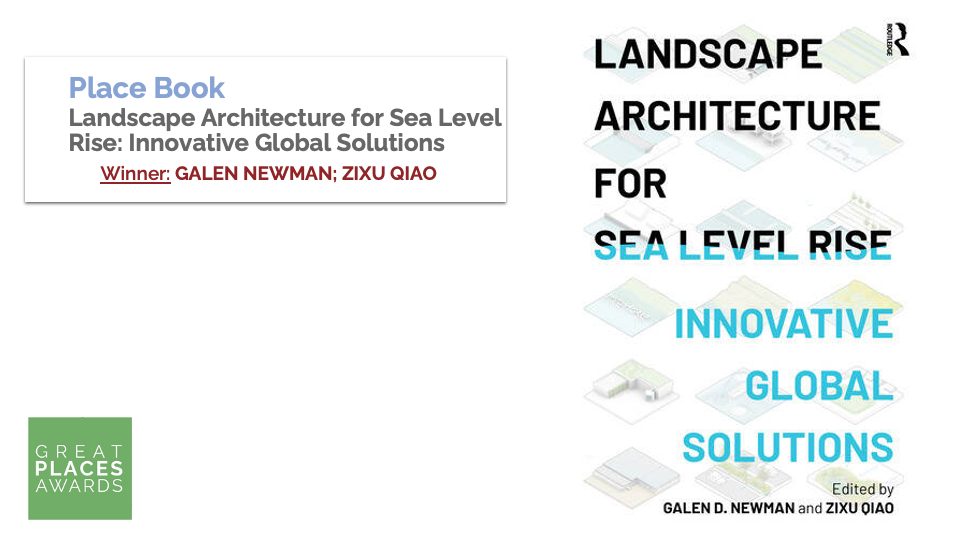
Place Book
Winner
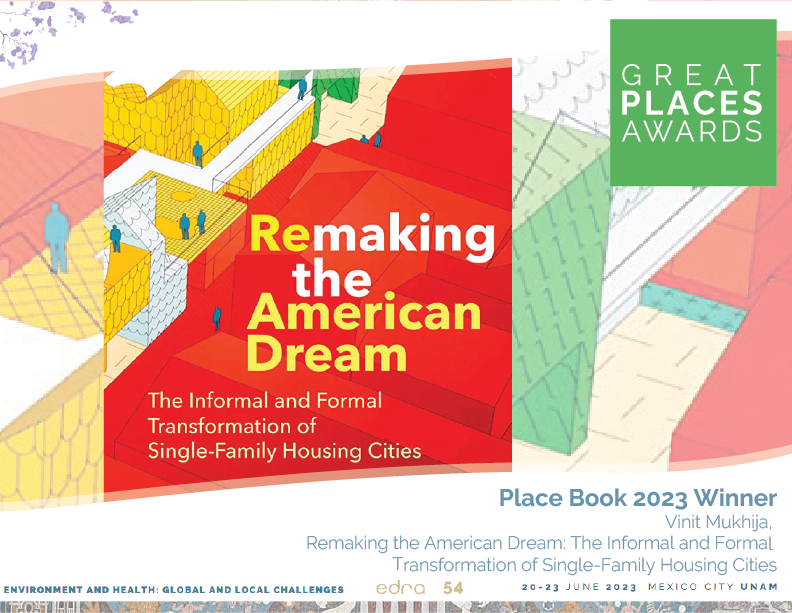
Remaking the American Dream: The Informal and Formal Transformation of Single-Family Housing Cities
Vinit Mukhija
In a discourse that is often dominated by large-scale policy debates, Remaking the American Dream brings the housing crisis down to the scale of people and place. A thorough and rigorous study of single-family housing, this book focuses on the critical exploration of unpermitted second units in certain cities of the United States, with a focus on Los Angeles, and their relationships with urban density, transportation, and informal construction. This timely text is organized under a clear structure that offers a concise and rigorous framework for the study. The charts and diagrams provided by the author are particularly valuable as they incorporate a graphic understanding of the problems, opportunities, and case studies that complement the text analysis. The book includes an extensive bibliography that becomes a key resource for the reader.
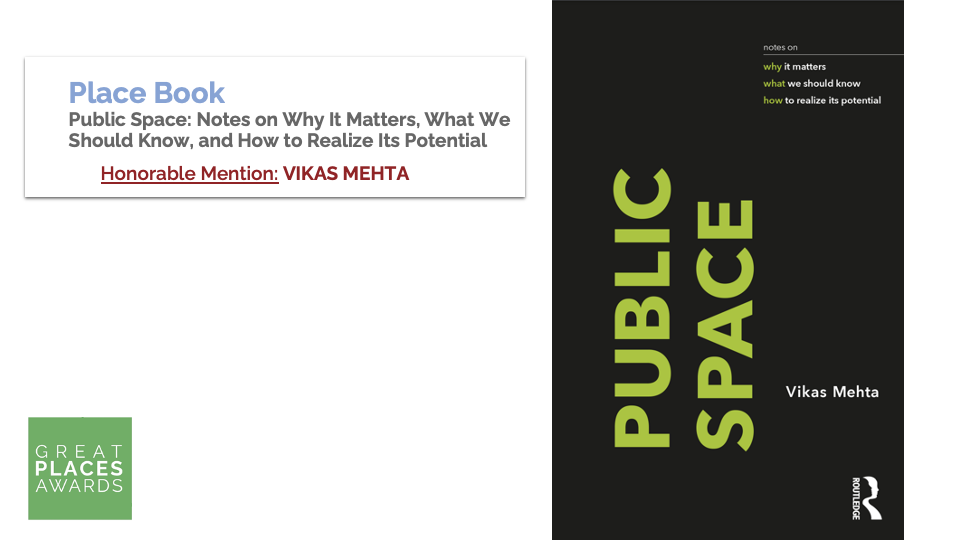
Honorable Mention
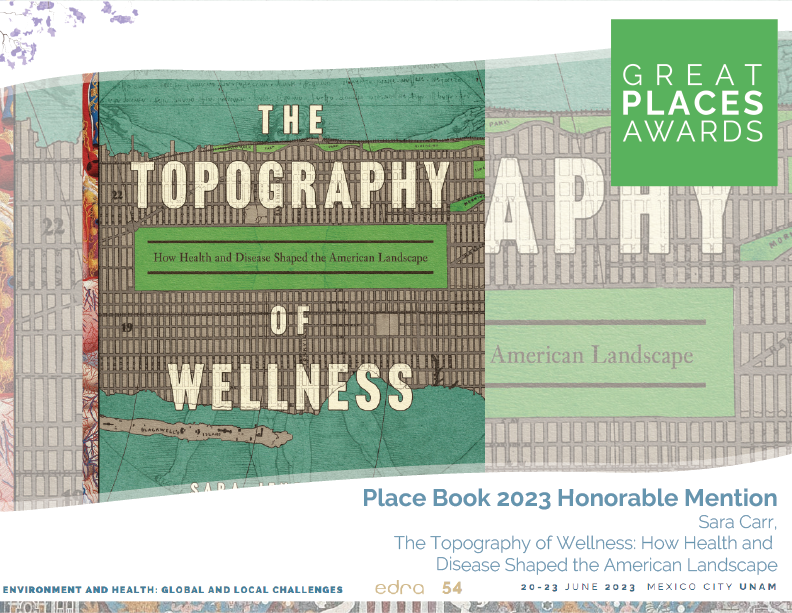
The Topography of Wellness: How Health and Disease Shaped the American Landscape
This book addresses important questions about contemporary health and urban life, highlighting how both infections disease and chronic disease have shaped the built environment. The book is well-written, making the topic accessible and informative. Given the recent Covid pandemic, The Topography of Wellness offers a valuable resource for designers, policy makers and healthcare professions alike. As a result, the book has been both positively received in the academic literature and widely distributed through popular media.
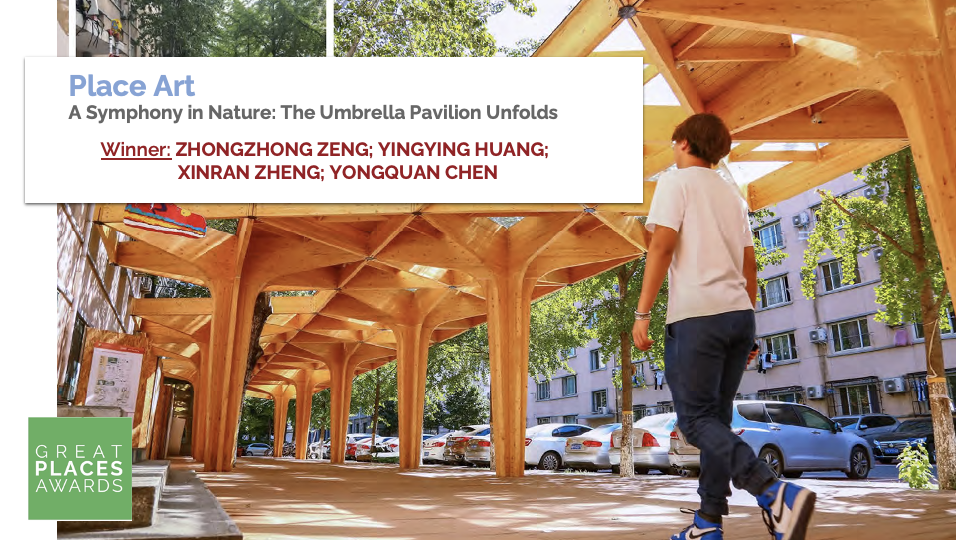
Place Art
Winner
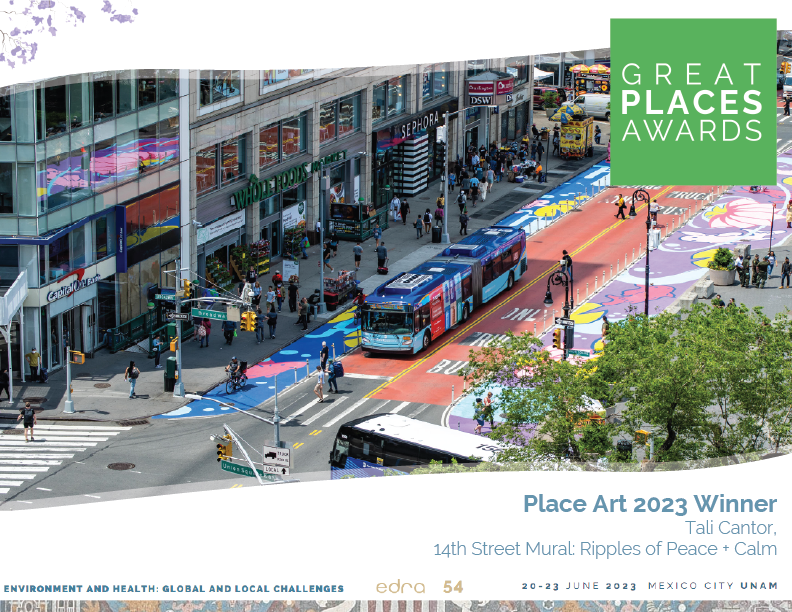
4th Street Mural: Ripples of Peace + Calm
The 14th Street Mural activates and reclaims a busway adjoining Union Square in NYC. Its design responds to pressing socio/political issues – specifically the crimes and hostility towards the Asian American and more broadly BIPOC communities – and offers a simple yet bold response. The mural’s design incorporates imagery recalling traditional Asian motifs, engendering tranquility in a contemporary and sophisticated way. As such this public artwork is a sublime response to anger, violence and evil. It is advocacy at its best: powerful but serene, authoritative but gentle. “Ripples of Peace + Calm” is a beautiful work, a beautiful design well executed.
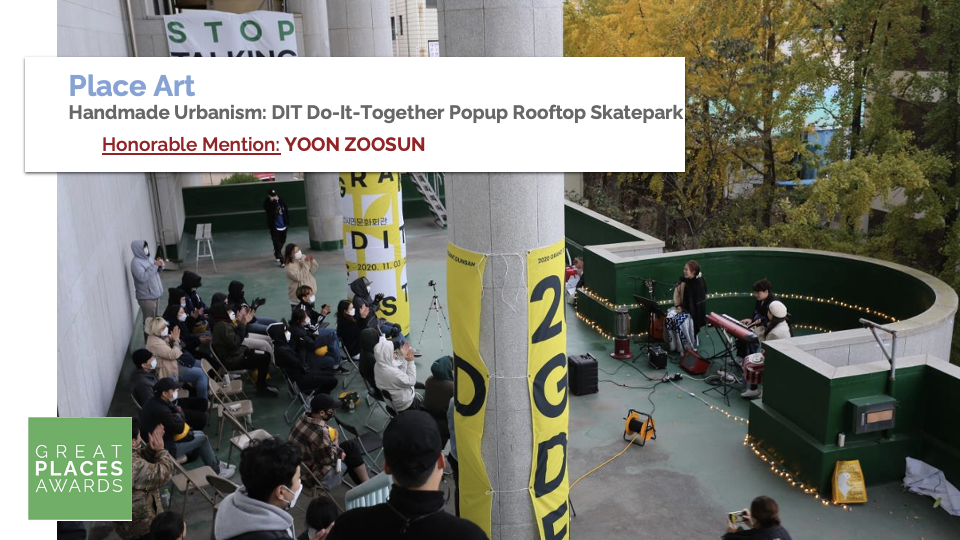
Honorable Mention
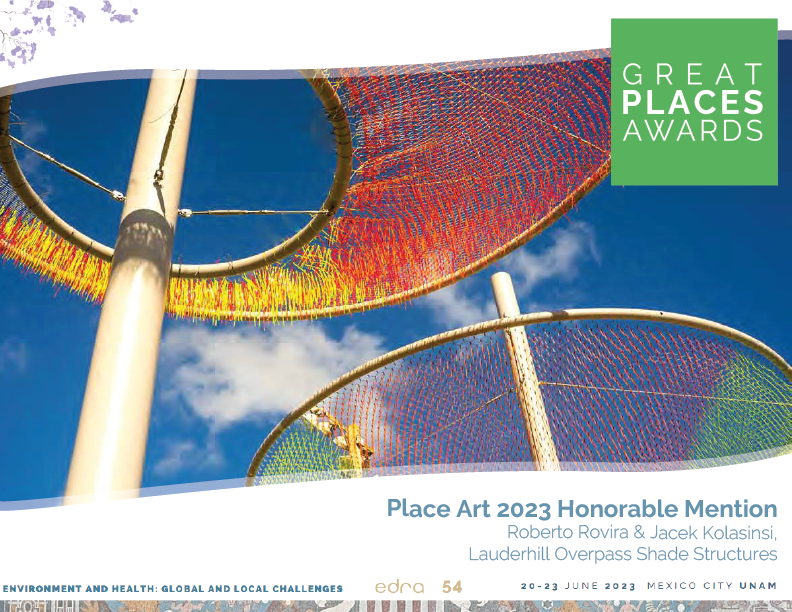
Lauderhill Overpass Shade Structures
Through extensive and ongoing engagement and participation this project created a strong community presence and sense of ownership of a derelict yet vital pedestrian highway crossing. The infrastructural quality of the Lauderhill Overpass Shade Structures is softened through the use of thousands of colorful zip ties, attached with the labor and love of many volunteers, primarily school children. The resulting visual impact of the Shade Structures is impressive, creating something beautiful in an otherwise depressed and underserved area and resulting in a safer, and certainly more delightful place.
2022 EDRA GPA AWARD RECIPIENTS
Place Design
Winner
The Seattle Street Sink
Elizabeth Golden, Brice Maryman, Richard Mohler
Honorable Mention
Yanaguana Garden
Daniel S. Iacofano, ML Rhee
Place Planning
Winner
Greater Northside Urban Design Toolkit
Susan Rogers
Honorable Mention
Longfellow Middle School: Sharing Space for Equitable Design
Patricia Algara, Jessica Rozul
Place Research
Winner
The Campus Landscape As Laboratory: Experiential Learning, Research, Outreach, and Stewardship
A. Kiers, Patsy Owens
Honorable Mention
A Workplace for Employee Wellness & Community Connection
Jeri Brittin
Place Book
Winner
Cities for Life: How Communities Can Recover from Trauma and Rebuild for Health
Jason Corburn
Honorable Mention
Restorative Cities: Urban Design for Mental Health and Wellbeing
Jenny Roe, Layla McCay
Honorable Mention
The Routledge Handbook of Designing Public Spaces for Young People: Process, Practices and Policies for Youth Inclusion
Patsy Owens, Sarah Little, Janet Loebach, Adina Cox
Place Art
Winner
Emily Kutil
2021 EDRA GPA AWARD RECIPIENTS
Place Design
Winner
The Steps at Bandra
Alan and Anca Abraham
Honorable Mention
Design for Distancing
Briony Hynson
Place Planning
Winner
Town Common Masterplan
Rhodeside and Hardwell
Honorable Mention
White Flowers Boulevard
Nadezda Snigireva
Place Research
Winner
“Growing Up with No Place to Play: A Participatory Study of Children’s Public Spaces in Manila’s Resettlement Communities”
Lyndsey Deaton
Honorable Mention
A Comparative Analysis of Visualization Methods in Architecture: Employing Virtual Reality to Support the Decision-Making Process in the AEC Industry.
Ahmed Gheraba
Place Book
Winner
Case Studies in Retrofitting Suburbia: Urban Design Strategies for Urgent Challenges
June Williamson and Ellen Dunham-Jones
Honorable Mention
Designing Streets for Kids
Annah MacKenzie and Annie Peyton
Place Art
Winner
Assembly House: A Living Workspace of Social and Material Connections
Dennis Maher
Honorable mention
Punto Urban Art Museum
David Valecillos
2020 EDRA GPA AWARD RECIPIENTS
(click on the images to view project summary PDF)
Place Design - Winner
City Thread
Molly Hunker and Greg Corso
"The jury selected this project as a memorable contribution to the mission of the Environmental Design Research Organization. The project excels in supporting a wide range of activities with a simple, flexible, and recognizable structure, resulting in an infrastructure for urban life in an alleyway. Produced with stakeholder input, the installation unifies different voices by enabling a broad range of possible programs without prescribing any. Jurors appreciated the strong, iconic design language, and congratulate the design team on achieving a project that presents a skillful balance of responding to specific current needs and remaining open to future change."
Place Design - Honorable Mention
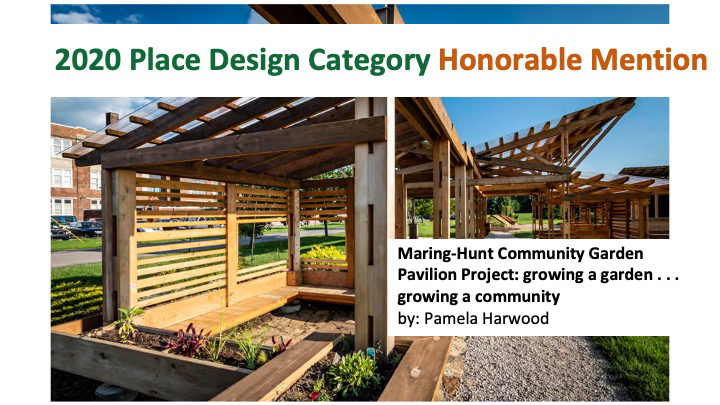
"Gateway to Growing: Maring-Hunt Community Built Market Pavilion, Outdoor Kitchen, and Nature Play Pockets"
Pamela Harwood
"We commend this project's exemplary process of engagement with neighbors and students that led to a lively destination for daily neighborhood use and seasonal festivals alike. This careful work with neighborhood needs is complemented by a rigorous design and construction process."
Place Planning - Winner
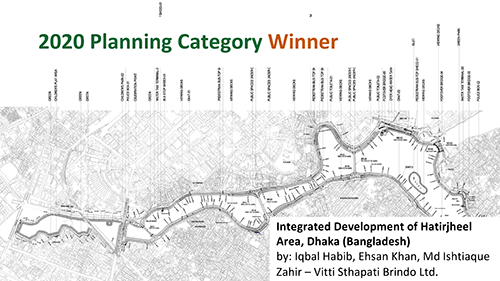
"The Integrated Development of Hatirjheel Area"
Ishtiaque Zahir, Ehsan Khan, and Iqbal Habib
"This is truly a wonderful water restoration and public realm reclamation project in the context of Dhaka, the capital of Bangladesh. The masterplan is implemented and represents an outstanding achievement in the way it sets a precedent for multifunctional public realm development. The interventions are well designed and will have a lasting positive impact on this city. Initially conceived as a wetland restoration project, it eventually became a comprehensive urban renewal project that promotes east-west vehicular and pedestrian connectivity, reduces vehicular traffic congestion, reintroduces waterways as a means of transportation, retains water during monsoon, manages waste water and drainage, protects the wetland from further encroachment, and provides much needed recreational and civic facilities for citizens."
Place Planning - Honorable Mention
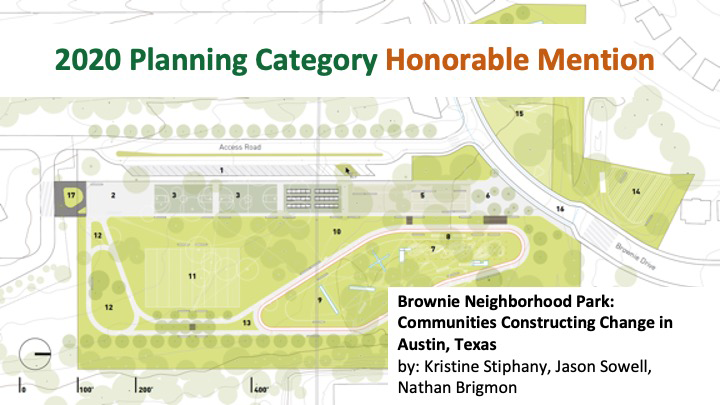
"Brownie Neighborhood Park"
Kristine M Stiphany, Jason Sowell, and Nathan Brigmon
"Clearly articulated goals of providing safe, public greens by re-using urban fragments are achieved in this proposal for a low-income neighborhood in Austin, Texas. The design and graphics are concise and well developed. This proposal represents a very attainable development with a clear impact on the residents of this area. Conceived during a series of public engagement workshops that encouraged residents and users to participate in the design of the park, this design provides a vision for the future development of this park."
Place Research - Winner
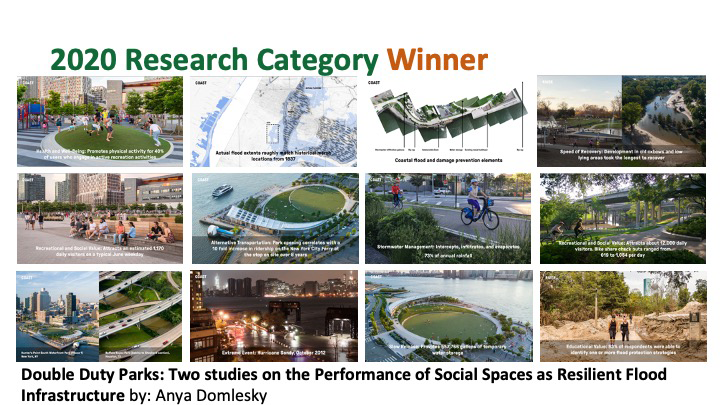
"Double Duty Parks: Two Studies on the Performance of Social Spaces as Resilient Flood Infrastructure"
Anya Domlesky
"The timeliness and intersectionality of the need to reduce the impacts of climate change together with social responsiveness make “Double Duty Parks” standout. The two case studies presented approaches to making flood-resilient infrastructure into attractive, accessible public parks/spaces. The research provided a good understanding of both the projected performance of the design to reduce environmental damage due to disasters, and what design features led to these projects becoming utilized, social and recreational spaces. The case study information made available at landscapeperformance.org is quite exceptional and provides an exemplar for how to present practice-based research. Moreover, the projects resulted in increasing public health and well-being along with an educational and interpretive component of enabling local citizens to learn about the dangers and protections. Overall, these excellent projects lead the way in showing how multiple complex goals can be incorporated in the creation of highly successful environments."
Place Research - Honorable Mention
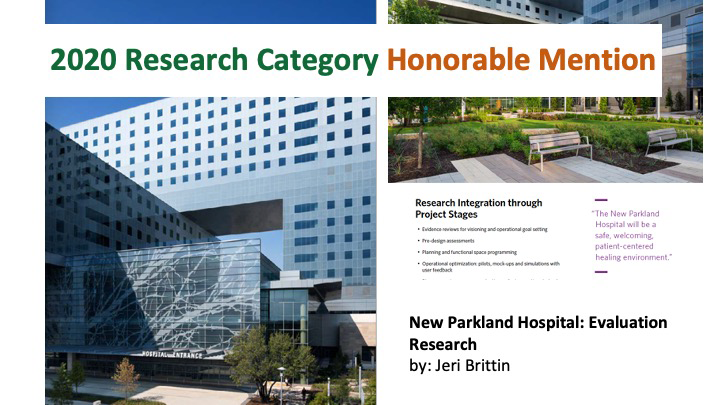
"New Parkland Hospital Evaluation Research”
Dr. Jerri Brittin
"This is very strong applied research, presented in a compelling fashion. The project began with the idea that the physical environment of hospitals can contribute to patient outcomes, patient and staff experience, and quality of care in health care settings and that Post Occupancy Evaluation (POE) research can help in this. The hypotheses explored these using multiple data sources including archival data (patient & safety records), surveys, and focus groups. The research raised questions about the universal efficacy of decentralized nursing. Though the research results were not all unequivocal, the new hospital facilities resulted in increased patient satisfaction, seemed to be liked by the staff, and from the pictures appear spacious, welcoming and color coordinated. The study has been well disseminated and its impact well documented. A great example of how evidence from POE research can lead to good design."
Book Award - Winner
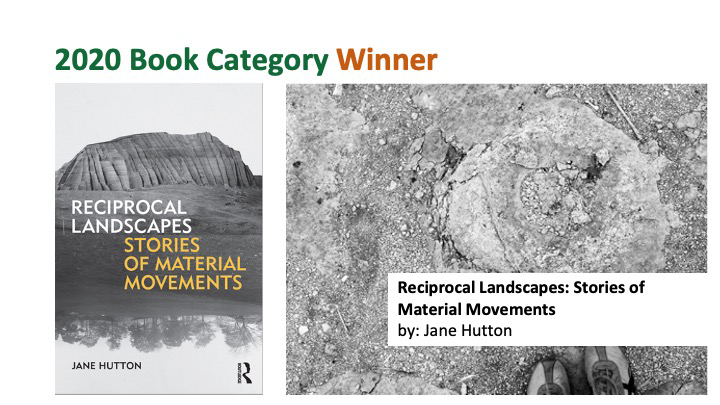
"Reciprocal Landscapes. Stories of Material Movements"
Jane Hutton
"Inspired by the work of Robert Smithson ‘non-site’, this memorable and timely book stands out as an novel perspective on ‘everyday landscape construction materials’ in the context of well-known public landscapes in the city of New York– revealing otherwise invisible stories of the sites from which the materials originate. The book is articulated through a clear structure, and a chapter is devoted to each material with the stories of the original sites -considering social, political and ecological entanglements of material practices. The book is well written, accessible, and a must read."
Book Award - Honorable Mention
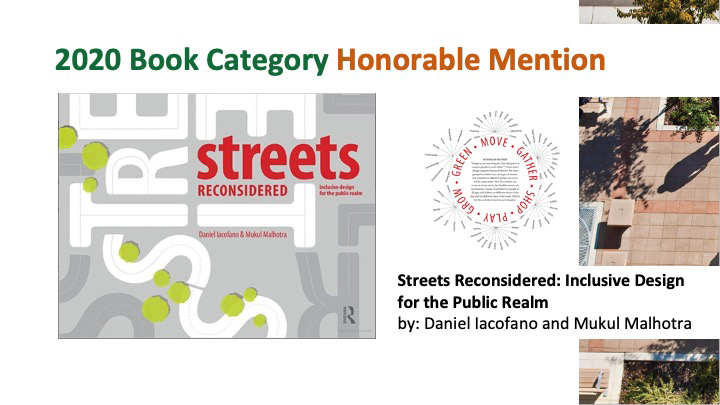
"Streets Reconsidered: Inclusive Design for the Public Realm"
Daniel Iacofano and Mukul Malhotra
"A compelling book that calls for a fundamental rethinking of America’s streets by designing them for living in addition to driving. Case studies from around the world are used to illustrate significant strategies such as accommodating people of all ages and abilities, varied travel modes, social interaction and economically viable business transactions. The design aspects are illustrated through wonderful photographs and beautiful drawings and renderings. Easily read and clearly explained and illustrated, the book should be in the library of every municipal planning department, urban design firm, landscape architecture offices and community organizations promoting healthy living and great human spaces."
2019 EDRA GPA AWARD RECIPIENTS
(click on the project title for project details)
Book Category Honorable Mention
Interpreting Kigali, Rwanda: Architectural Inquiries and Prospects for a Developing African City
Korydon Smith, University of Buffalo and Toma Berlanda, University of Cape Town, South Africa
While one-quarter of the world’s population lives in informal (“squatter”) settlements, there has not been a proportionate amount of environmental design research, urban planning, or architectural design in these contexts. This is particularly the case for urban sub-Saharan Africa, where populations are growing rapidly and where self-built urban settlements are anticipated to double in size within one generation. Interpreting Kigali, Rwanda, fills a major research gap and provides a bridge toward implementing sustainable solutions to neighborhood planning and housing design in a rapidly growing African city. The book grows out of a series of design studios based in Kigali. The work combines archival, historical, and field research with a young-but-growing body of work on informal settlements throughout the Global South.
Book Category Honorable Mention
Making Places for People: 12 Questions Every Designer Should Ask
Christie Johnson Coffin and Jenny Young, University of Oregon.
Combining research and case studies, "Making Places for People" helps make the field of environment-behavior studies inspirational, relevant and accessible to a wide range of design professionals, academics, students, and laypeople. The authors explore social questions in environmental design, bringing perspectives from practice, teaching and research to challenge assumptions about how places meet human needs.
Place Design Category Winner
An Intimate Exchange: Bridging the Divide between Refugees and Their Hosts.
Submitted by: Daniel Winterbottom, University of Washington
There are an estimated 116,000 Syrian civil war refugees living in Sweden. Most have been re-settled in rural villages like Dals Lagden, living parallel lives to their Swedish neighbors. Segregated in their own neighborhoods, refugees often remain physically and socially isolated from the greater Swedish community. There are venues of mixing, sports being a good example, but integration has been a slow and arduous process. The project focuses on the universal human rituals surrounding food and bathing, namely the sauna, to bring these disconnected communities together. Participation in intimately held, shared rituals erodes barriers to social cohesion, cultural exchange and understanding and transforms individuals’ relationships to one another and the community as a whole. The site also functions as a gateway into the village, a village that lacked a community “heart” or commons. Visitors and locals alike are met with a space that is welcoming, active, egalitarian and based in practical needs and uses. In these shared endeavors, dialogue ensues and insights are gleaned reducing the perceptions of the “other”. Through this intentionally designed setting, stories are exchanged and friendships forged.
Place Design Category Honorable Mention
Fowler-Clark-Epstein Urban Farm
Submitted by: Keith Zaltzberg, Regenerative Design Group
"Firmly rooted in ecological design, the Fowler Clark Epstein Urban Farm responds to the social and environmental needs of today, while reviving the story and uses of a historic Boston farmstead. Built on a site that was slated for a housing development, this project came about through the work of multiple stakeholders, and is one of the first to implement the city’s zoning provisions to support urban farming. The goals were ambitious: to transform a neglected corner lot in Mattapan - one of the most under-resourced neighborhoods in Boston - into a beautiful, ecologically resilient, historically sensitive, accessible, and agriculturally productive landscape. Today, a dedicated staff works on site to grow food, train farmers, and build community."
Planning Category Winner
New Beginnings Homeless Transition Village: A Permittable Settlement Pattern
Submitted by: Stephen Luoni, Shawna Hammon, Ethan Kaplan, Charles Sharpless, Garrett Grelle, and Linda Komlos with the University of Arkansas Community Design Center; John Langham with WER Architects/ Planners; Steve Marshall with the Marshall Group of Northwest Arkansas; Kevin Fitzpatrick with the University of Arkansas, J William Fulbright, College of Arts and Sciences; Ken Overman with Omni Engineers; Leslie Tabor of Leslie Tabor Landscape Architects; Neal Morrison with Morrison-Shipley Engineers, Inc. and Mike Rusch with Serve Northwest Arkansas.
"More than three million Americans experience homelessness annually. Emergency shelter capacity is limited while governments are unable to provide temporary housing. Informal self-help shelter solutions are now popular adaptive actions despite nonconformance with city codes. Unfortunately, most informal solutions have resulted in objectionable tent cities and squatter campgrounds where the local response has simply been to move the problem around. Working for sociologists holding expertise in homelessness and a homeless services provider, we collaborated with city officials and engineering consultants to develop a prototype transition village that replaces a tent city near downtown. The project plan prototypes a shelter-first solution (with wraparound social services) using a kit-of-parts that can be replicated in other communities. The village design reconciles key gaps between informal building practices and formal sector regulations, creating a permittable solution under most city codes."
Research Category Winner
Submitted by Brett Snyder - Department of Design, University of California, Davis.
"The place research represented by the Alameda Creek Atlas, is part of multi-pronged effort to build resilience to climate impacts in the watershed through planning and design for sediment transport and Steelhead Trout habitat. Engaging communities and stakeholders within the research and planning of the watershed supported the creation of a feed-back loop, whereby local experts shared broad and diverse conceptualizations of the watershed as a place to the design and research team, and project members then reflected these conceptualizations back to inform a constituency that might advocate for the necessary changes within the watershed."
2018 EDRA GPA AWARD RECIPIENTS
Place Design Award
Designed by Ram Eisenberg
Place Planning Award
Place Book Awards
Design as Democracy: Techniques for Collective Creativity
David de la Pena, Diane Jones Allen, Randolph T. Hester, Jeffrey Hou, Laura J. Lawson, and Marcia J. McNally. Published by Island Press (2017)
Creating Healthy Neighborhoods: Evidence-Based Planning and Design Strategies
Ann Forsyth, Emily Salomon, and Laura Mead. Published by Routledge (2017)
2017 EDRA GPA Award Recipients
Place Design Award
Mariahilfer Strasse, Vienna
Place Planning Award
Making Our Own Space (MOOS)
Place Research Award
Dean Apostol, James Palmer, Martin Pasqualetti, Richard Smardon, and Robert Sullivan
Place Book Award
Designing for Autism Spectrum Disorders
Kristi Gaines, Angela Bourne, Michelle Pearson and Mesha Kleinbrink
2016 EDRA GPA Award Recipients
Place Design Award
An Outdoor Learning Environment for Children.
Matluba Khan, University of Edinburgh. Tulatoli Government Primary School, Bangladesh
Place Planning Award
Akron Better Block
Jason Roberts North Hill neighborhood in Akron, Ohio
Funded by the John S. and James L. Knight Foundation
Place Research Award
Cognitive Architecture: Designing for How We Respond to the Built Environment
Ann Sussman, and Justin B. Hollander Published by Routledge
Place Book Award
Therapeutic Gardens: Design for Healing Spaces
Daniel Winterbottom, and Amy Wagenfeld, (2015) Published by Timber Press, Inc.
2015 EDRA GPA Award Recipients
Community Matters: Service-learning in Engaged Design and Planning, New York, NY:Routledge/Earthscan
Roosevelt Plaza Pop-Up Park, Group Melvin Design, Sikora Wells Appel, City of Camden, Cooper’s Ferry Partnership
Upper Lawrenceville Community Visioning Targeted Development Strategy, evolveEA
Daniels Spectrum - Regent Park, Toronto, Diamond Schmitt Architects
Race & the Control of Public Parks, buildingcommunityWORKSHOP
Fayetteville 2030: Food City Scenario, University of Arkansas Community Design Center
2014 EDRA GPA Award Recipients
The Masaro Village Project, GA Collaborative
Open House, Matthew Mazzotta, Coleman Center for the Arts
Sugar Beach, Claude Cormier et Associés
Pike Pine Renaissance, Gustafson Guthrie Nichol
The Street, Vikas Mehta
2013 EDRA GPA Award Recipients
1315 Peachtree Street, Perkins + Will
Dublin Grounds of Remembrance, PLANT Architect Inc.
Unified Ground: National Mall Competition, Union Square (Washington, D.C.), Gustafson Guthrie Nichol
Northerly Island Park Framework Plan, SmithGroupJJR, Inc./Studio Gang Architects
Pop Up City: Temporary Use Strategies for a Shrinking City, Cleveland Urban Design Collaborative, Kent State University
WaterFire Providence, WaterFire Providence - a non-profit arts organization
Urban Composition, Mark C. Childs
2012 EDRA GPA Award Recipients
Escuela Ecologica Saludable Initiative: Parque Primaria Pitagoras, Benjamin Spencer, Department of Landscape Architecture, University of Washington
Urban Strategies in Historic Beijing, Irma Ramirez, California State Polytechnic University Pomona School of Environmental Design
Owe’neh Bupingeh Preservation Project, Shawn Evans, AIA, Atkin Olshin Schade Architects
Insurgent Public Space: Guerrilla Urbanism and the Remaking of Contemporary Cities, Jeffrey Hou
2011 EDRA GPA Award Recipients
The Steel Yard, Klopfer Martin Design Group
Steelbridge Skatepark Development Plan, City of Portland/Portland Parks/DAO Architecture
Measured Change: Tracking Transformations on Bayou Lafourche, LSU Coastal Sustainability Studio
Cities for People, Jan Gehl
2010 EDRA GPA Award Recipients
Garbage to Gardens, Guatemala City, Guatemala Associate Professor Daniel Winterbottom, Univ. of Washington Dept. of Landscape Architecture with students of the Guatemala design/build studios
Visioning Rail Transit in Northwest Arkansas 2030 Univ. of Arkansas, Community Design Center and School of Architecture; Washington Univ., St. Louis, Sam Fox School of Design & Visual Arts
Maasvlakte 2100: A Long Term Design Strategy for the Port Lands of Rotterdam Open Systems, Pierre Belanger, Miho Mazereeuw
Battery Park City Streetscapes & Security Rogers Marvel Arch., James Carpenter Des. Assoc., Ducibella Venter & Santore, Sam Schwartz Co. LLC, Weidlinger Assoc., Fisher Marantz Stone, Robert Silman Assoc., Langan Eng. & Env. Ser., U.S. Army Eng. Res. & Dev. Ctr.
CITY SINK: Carbon Storage Strategies for Urban Landscape, Denise Hoffman Brandt
Greening Cities, Growing Communities: Learning from Seattle's Urban Community Gardens, Jeffrey Hou, Julie M. Johnson and Laura J. Lawson
SOAK: Mumbai in an Estuary, Anuradha Mathur and Dilip da Cunha
2009 EDRA GPA Award Recipients
The Norwegian National Opera and Ballet,Craig Dykers, Tarald Lundevall, Kjetil Traedal Thorsen
Wing Luke Asian Museum, Olson Sundberg Kundig Allen Architects
Vision 2030: West Dallas Gateway, Strategic Framework Initiative, Univ. of Texas, Dallas Urban Laboratory
Guangming Sustainable Park, CJ Lim, Studio 8 Architects
Resuscitating the Fez River: Procedures to Create New Public Space in the Medina of Fez.Takako, Tajima, Aziza Chaouni, Bureau E.A.S.T.
Design for Health: University of Minnesota, Cornell University, University of Colorado, Dr. Ann Forsyth, Dr. Kevin Krizek, Dr. Carissa Schively Slotterback, Amanda Johnson, Aly Pennucci, Michael Huber.
Daring to Look: Dorothea Lange’s Photographs and Reports from the Field, Anne Whiston Spirn
2008 EDRA GPA Award Recipients
Olympic Sculpture Park, Seattle, WA WEISS/MANFREDI Architecture/Landscape/Urbanism Ballard Library and Neighborhood Service Center, Bohlin Cywinski Jackson
RIVER + CITY + LIFE: A Guide to Renewing Toronto’s Lower Don Lands, Stoss Landscape Urbanism
The Arc: A Formal Structure for a Palestinian State, Suisman Urban Design, with RAND Corporation
Historic Chicago Greystone Initiative, City Design Center, University of Illinois at Chicago, College of Architecture and the Arts
The Landscape Totems: Speculations on Growth and Decay, Kristi M. Dykema
America Town: Building the Outposts of Empire, Mark L. Gillem
2007 EDRA GPA Award Recipients
Ferry Building, SMWM (Architect); Baldauf Catton von Eckartsberg Architects (Retail Architect); Page & Turnbull (Preservation Architect); Owner: Port of San Francisco; Developers: Equity Office, Wilson Meany Sullivan LLC, Primus Infrastructure LLC
The House of Dance and Feathers Mardi Gras Indian Museum, Project Locus: Patrick Rhodes, Executive Director, Lower Ninth Ward, New Orleans, LA
Intertwined Human + Environmental Ecologies: The Money Point Sustainable Revitalization Plan, Crisman+Petrus Architects; University of Virginia School of Architecture; UVA Institute for Environmental Negotiation; The Elizabeth River Project.
Los Angeles River Urban Wildlife Refuge: A Vision for Parks, Habitat, and Urban Runoff, Community Development by Design
Defiant Gardens: Making Gardens in Wartime, Kenneth L. Helphand
Living Memorials National Research: 9/11 and the Public Landscape, Erika Svendsen and Lindsay Campbell, USDA Forest Service, Northern Research Station